

Beyond the first generation, facelifts for the Škoda Octavia have always been relatively significant. Most changes have typically focused on the front headlights, and the fourth-generation facelift of this Czech bestseller is no exception, though the updates are less dramatic than before. We reviewed the refreshed Škoda Octavia during an editorial test of the liftback variant, equipped with Sportline trim and a 150-horsepower mild-hybrid petrol engine.
Subtle updates
The fourth-generation Škoda Octavia’s facelift is most noticeable from the front. The headlights now feature a more complex design, extending downward toward the bumper near the grille, creating a subtle “notch.” However, this design change is not immediately apparent as it blends seamlessly with the black trim of the grille.

The headlights remain full LED as standard, with optional Matrix-LED technology boasting 36 individual lighting segments in its second generation. The design of the daytime running lights (DRLs) varies depending on the headlight type. Basic headlights feature a single DRL line at the bottom, extending from the outer edge toward the “notch.” With the Matrix-LED option (as in our test car), the DRLs are more intricate, positioned at the top of the headlight, with lines extending downward.
Changes extend to the rear light graphics, similar to the updated Scala and Kamiq models. Instead of a continuous light strip, they now feature small, unlit segments. Both bumpers have also been redesigned, though the changes are modest, resulting in a 9-mm increase in length to 4,698 mm. Additionally, new wheel designs are available.
The interior remains largely unchanged, with updates focusing on materials—both on the dashboard and upholstery—and electronics. A digital cockpit is now standard across all versions, though the basic version differs from the more sophisticated options available in higher trims. Another addition is the larger central infotainment display, with sizes up to 13 inches. The multimedia control bar below it is now backlit, making it easier to use in the dark.

Engine and drivetrain updates
Under the hood, the 1.0-liter three-cylinder engine has been replaced by the equally powerful 1.5 TSI. However, this new engine feels less lively than its predecessor. The plug-in hybrid versions (available in both standard and RS trims) have been discontinued, and the flagship RS now exclusively features a 2.0-liter petrol engine. Diesel options remain available for standard trims, with outputs ranging from 85 kW (115 hp) to 195 kW (265 hp). Front-wheel drive is standard, with all-wheel drive offered for the most powerful variants. Entry-level engines come with manual transmissions, while higher-powered options include DSG automatic gearboxes.
The RS diesel and Scout variants are no longer available. Škoda has also revised its trim level nomenclature, introducing options like Essence, Selection, Top Selection, Exclusive Selection, Sportline, and RS.
Behind the steering wheel
Our test vehicle looked genuinely impressive in person. This is largely thanks to the Sportline trim, which offers rich equipment, stylish wheels, and black design accents, such as the rear lip spoiler. The standout feature, however, was the Italy Blue paint, which gives the car a striking appearance.

Inside, the Sportline trim adds features not found in standard versions. These include a different steering wheel design, integrated headrests in the front sport seats, stainless steel pedal covers, dark decorative trim on the sills, and carbon-look dashboard elements. This trim resembles the top RS model, despite allowing a wide choice of engines.
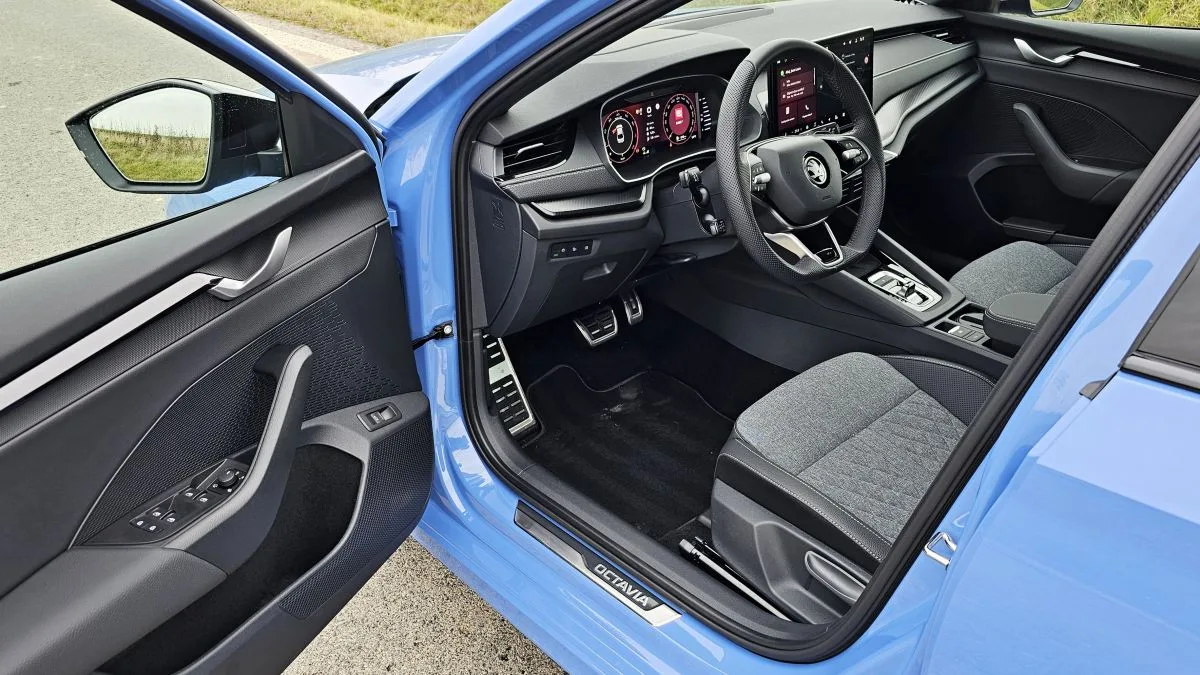
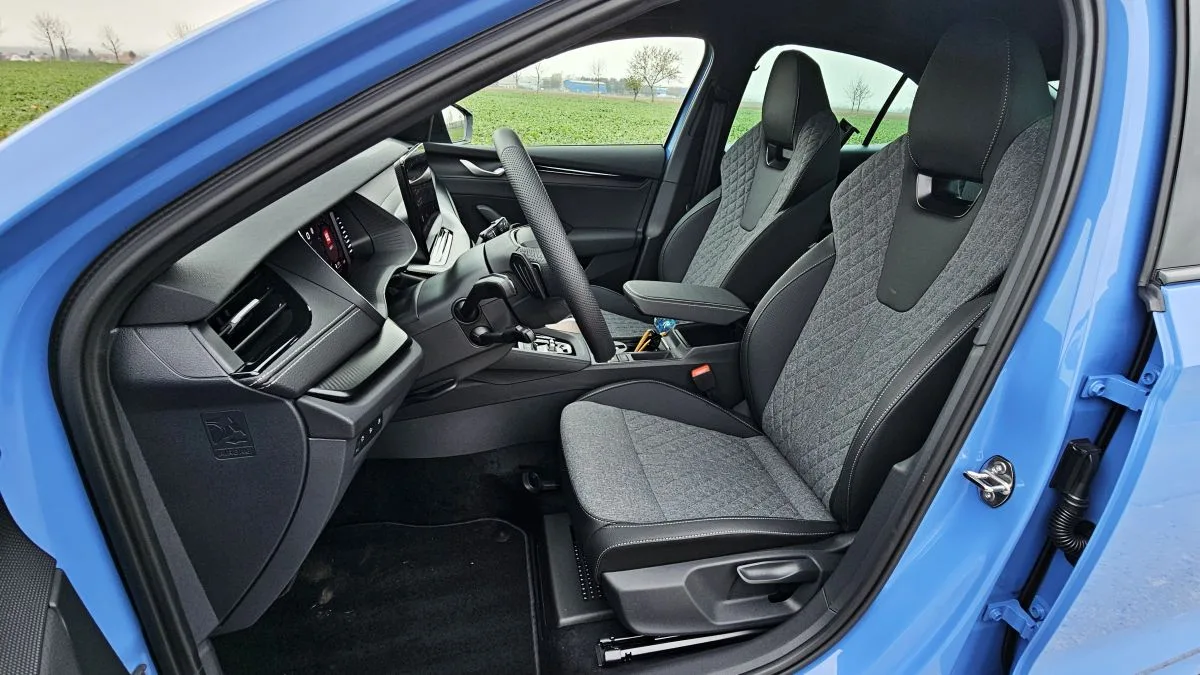
Our test model featured the 1.5 TSI mild-hybrid four-cylinder engine with 110 kW (150 hp), paired exclusively with a DSG gearbox and front-wheel drive. Surprisingly, this combination felt more than adequate. The car is neither slow nor sluggish, offering lively and agile handling in corners. Its lowered suspension (15 mm lower than standard versions) enhances cornering stability. Additionally, the adaptive DCC suspension can be adjusted from surprisingly soft (though not as cushy as the new Kodiaq) to fairly firm, but never excessively harsh. The default “normal” setting, tuned by Škoda, strikes a perfect balance, ensuring a smooth ride over uneven roads.
The mild-hybrid engine does not offer pure electric driving but can coast with the engine off. When you lift your foot off the accelerator, the engine shuts down (under certain conditions), reducing drag without compromising onboard systems. As soon as you press the accelerator or brake, the engine restarts seamlessly.

However, this mild-hybrid system has one drawback related to braking. During highway deceleration (e.g., approaching an off-ramp), the brakes initially engage normally. After a brief pause, the braking intensity lessens slightly, even if you maintain constant pressure on the pedal, before returning to normal. While a minor issue, it was consistently noticeable and somewhat unsettling.
The mild-hybrid system also incorporates cylinder deactivation to improve fuel efficiency. At low loads (e.g., cruising on flat terrain), the engine occasionally switches to two-cylinder mode, altering the engine note slightly. If additional power is needed, the transition back to four-cylinder mode is instantaneous and barely perceptible. Real-world fuel consumption ranged from 6 to 7 liters per 100 kilometers, even in urban conditions.
Conclusion and pricing
The facelifted fourth-generation Škoda Octavia introduces subtle design updates, minor interior enhancements, and improved equipment options. It retains the practicality and functionality that have made it so popular. This car is well-suited for family vacations yet versatile enough for weekday errands or work commutes. In the Sportline trim, it looks particularly appealing, and even with one of the least powerful engines, it delivers adequate performance and favorable fuel economy.

Are there any downsides? Sure, but they are minor and unlikely to deter most buyers.
As for pricing, the new entry-level Essence trim with the 1.5 TSI engine (85 kW) starts at 569,900 CZK. However, this and the base 2.0 TDI (85 kW) are the only engines unavailable in the Sportline trim. The Sportline trim begins with the non-mild-hybrid 1.5 TSI (110 kW) and manual transmission at 799,900 CZK. The tested mild-hybrid DSG version starts at 849,900 CZK.


